I finished a very weird 4.98 miles this afternoon. First, the background: I've been sick for the last two weeks so I haven't run at all in that time. This morning my chest was still tight and I had a lingering cough, but I felt like a bowl of mud so I thought an easy run might lift my spirits.
The first thing I noticed was how smooth my stride was; lately I've been feeling like I come crashing down with each step, but today I was sinking smoothly into the knee and rolling into the push-off in one connected motion. It's strange to feel stronger after a long break, but it hasn't really been a break: I bike to and from school every day, I'm on my feet several hours a day for work, I lifted some big weights last week and I've been experimenting with some more aggressive yoga poses. So I think all of that translated into some extra strength in my quads and glutes.
As per usual after too miles I was fully warmed up and I felt great, so I decided to extend my run by a mile or two. But after three miles, it became harder and harder to maintain the 8-minute-per-mile pace that felt so comfortable when I started. I was trying to figure out what was going on when I remembered an old Joe Friel article about decoupling, which is where your heart race and pace are no longer connected. It's the metabolic indicator of fatigue, and it meant that the rest of my run was going to be tough.
I turned around and headed back to my apartment, but it took another two miles to get back, two heavy-legged, hard-breathing miles. I had a stressful week at school and I'm working two jobs, so I get up early and work late every weekday which takes its toll even without any running added into the mix. So that is the double-edged sword of being busy and doing a lot; you can't train hard every day like you might want, but with two weeks of almost no "exercise" and lungs that were probably a little virus-impaired, I still ran five miles in just over 40 minutes that were mostly easy.
P.S. Another weird thing about the run is that it was nearly 60 degrees out, so I went shirtless, which is bizarre for Utah in February. It was nice, but I read an article about how the warm winter could cause some kind of ecological catastrophe in the region later this year. That may be true, but for today, during my run, I didn't mind.
Saturday, February 14, 2015

Friday, January 2, 2015
Hearty Winter Recipes
I don't know what it is about cold weather that makes me so hungry, but after a long run through snow and ice a dainty salad is not enough; so here are two sturdy meals that will warm you, fill you up, and stick to your insides (they also cure insomnia, because they are nothing but starch and protein and slamming a couple of pounds of this stuff right before bed will knock you out better than any pharmaceutical.) Both have the same origin: one night I was tired and hungry and made whatever I could with the only ingredients I had on hand, and necessity is the mother of nearly everything good. Enjoy!
Sausage-Potato-Corn Hash
ingredients:
smoked sausage
frozen diced potatoes for frying
canned sweet corn
Sausage-Potato-Corn Hash
ingredients:
smoked sausage
frozen diced potatoes for frying
canned sweet corn
- Slice sausage and cook in a large pan on medium-high heat.
- Remove sausage and fry potatoes in the sausage fat (add vegetable oil if not enough fat rendered from the sausage.)
- Add corn, stir until just heated through (do not cook the corn; canned vegetables are already cooked.)
The contrast between the saltiness of the pork and the sweetness of the corn is great, and the potatoes round everything out.
___________________________________________________________
Shrimp and Sweet Potato Risotto
ingredients:
arborio rice
chicken stock
sweet potatoes
raw shrimp
- Bake sweet potatoes in oven until it's tender but can still hold it's shape (try 45 minutes at 390 degrees.) While doing that...
- Melt butter and olive oil in a saucepan, coat the rice, and cook briefly. Then add chicken stock gradually until the rice is as tender/firm as you prefer. Once the rice is started...
- Peel shrimp, toss them in olive oil, lemon juice, crushed garlic and cajun seasoning (I used paprika, cayenne, salt and pepper.) Broil until they just turn pink.
- When the three parts are done, stir them all together.
This one really blew me away; it takes some time but as risotto goes it's pretty simple and the flavors blend together perfectly.
Friday, December 19, 2014
Finally!
After weeks of unsuccessful attempts, I finally got to do a workout on the BYU indoor track. It's usually open most of the time, but lately whenever I've gone down there (even after calling the Richards Building front desk and receiving the assurance that it would be open) it's been closed, forcing me to jerry-rig another workout last minute.
But on this the last day of finals it was open. And who should I see sharing the track with me, but none other than Jared Ward:

Though his last year of NCAA eligibility was 2013 (the story of his final season was pretty bizarre, you can read about it here), I think he is still studying here as a graduate student. He was just jogging some easy laps and I was doing some short intervals, so I actually got to pass him which was pretty sweet. I wanted to talk to him and ask him how his running was going, but he left shortly after I got there (he was probably intimidated by my speed.)
But I felt like seeing Ward was a good portent. My workout was a two mile warm up, followed by 10 laps (1/5 mile each) at all-out pace with one minute recovery. From the splits you can tell it went very well:
.JPG)
1:04 translates to a 5:20 per mile pace, which is a good deal faster than anything I've been running lately. Next week I'll be in Oregon on Christmas vacation, and I plan to use the richer air to try breaking my 5K PR. Since my last race I knew that my biggest weakness was my aerobic capacity; so I've done lots of long intervals and hills to push my threshold. And I was making a lot of progress and feeling good, but I anticipated a problem; when I get down to sea-level and my lungs are no longer what's holding me back, if my legs still aren't used to moving that fast I'm going to have trouble holding that 6-minute-per-mile pace that I need. Hence the use of short-intervals for my final pre-race hard workout.
Now that the work is done it's time to take it easy, carbo-load with mountains of Christmas treats, and enjoy the spoils of my hard work. Wish me luck!
But on this the last day of finals it was open. And who should I see sharing the track with me, but none other than Jared Ward:
Though his last year of NCAA eligibility was 2013 (the story of his final season was pretty bizarre, you can read about it here), I think he is still studying here as a graduate student. He was just jogging some easy laps and I was doing some short intervals, so I actually got to pass him which was pretty sweet. I wanted to talk to him and ask him how his running was going, but he left shortly after I got there (he was probably intimidated by my speed.)
But I felt like seeing Ward was a good portent. My workout was a two mile warm up, followed by 10 laps (1/5 mile each) at all-out pace with one minute recovery. From the splits you can tell it went very well:
1:04 translates to a 5:20 per mile pace, which is a good deal faster than anything I've been running lately. Next week I'll be in Oregon on Christmas vacation, and I plan to use the richer air to try breaking my 5K PR. Since my last race I knew that my biggest weakness was my aerobic capacity; so I've done lots of long intervals and hills to push my threshold. And I was making a lot of progress and feeling good, but I anticipated a problem; when I get down to sea-level and my lungs are no longer what's holding me back, if my legs still aren't used to moving that fast I'm going to have trouble holding that 6-minute-per-mile pace that I need. Hence the use of short-intervals for my final pre-race hard workout.
Now that the work is done it's time to take it easy, carbo-load with mountains of Christmas treats, and enjoy the spoils of my hard work. Wish me luck!
Sunday, November 23, 2014
Kilometers instead of miles
After finishing my recent cross country race I was feeling pretty burned out so I took it easy for a couple of weeks to unwind. When I started running again I felt like I needed to change something, but couldn't put my finger on it. I went out for an easy run and found after a few minutes that my Garmin was still measuring kilometers instead of miles, and realized this was exactly the kind of change I needed.
I've always measured my runs in miles; I don't know why, I guess because that's the system of measurement we use for everything else. But races are usually measured in kilometers, and my workouts have been increasingly focused on my races, so the metric system seems like a more natural fit.
Another nice thing about the change is that runs seem to go faster when my watch is chirping the splits each kilometer instead of each mile; it breaks the workouts into small increments, and you get more frequent feedback on pace. So for now I'm enjoying the fresh perspective.
I've always measured my runs in miles; I don't know why, I guess because that's the system of measurement we use for everything else. But races are usually measured in kilometers, and my workouts have been increasingly focused on my races, so the metric system seems like a more natural fit.
Another nice thing about the change is that runs seem to go faster when my watch is chirping the splits each kilometer instead of each mile; it breaks the workouts into small increments, and you get more frequent feedback on pace. So for now I'm enjoying the fresh perspective.
Monday, November 3, 2014
USATF Cross Country
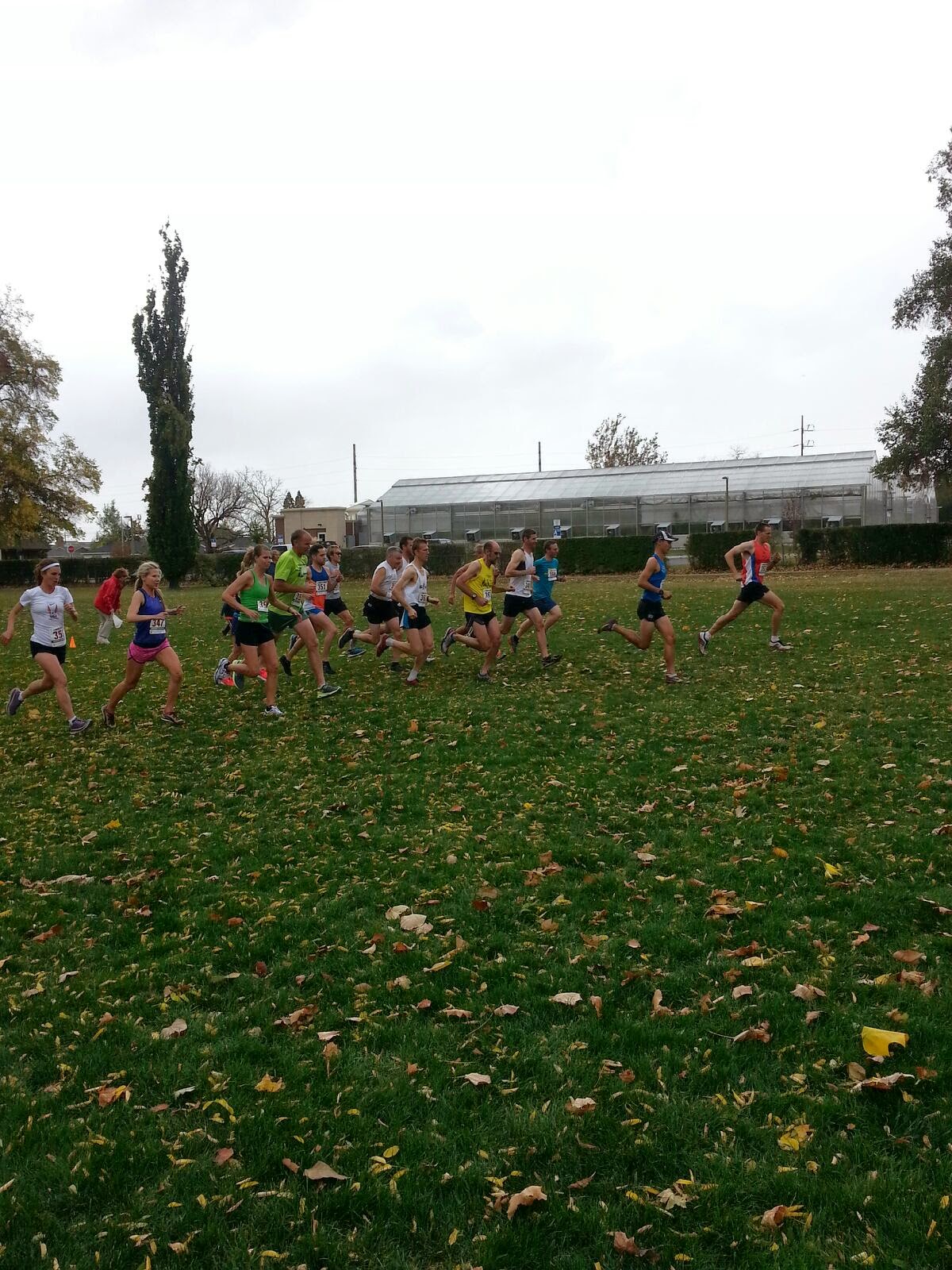
I took away two things from the 2014 USATF Utah Regional Cross Country Championship:
.jpg)
.jpg)
.jpg)
.jpg)
.jpg)
.jpg)

1. Cross Country is HARD!
2. Cross Country is definitely my favorite way to race.
I took out the first kilometer in 4:02, which was right around what I was shooting for. I was running hard but not all out, so I felt like I had some room to grow. But then kilometers 2, 3, and 4 had some hills. Quickly I was sucking air and trying not to panic. I had to slow down to about 4:20 per kilometer, but I told myself that it was OK to ease up, as long as I just kept going. The last half a kilometer or so was downhill so I was able to pick up the pace and have a strong finish.
The best thing about races is having other people to challenge you. During the middle portion I was hanging right behind these three guys that really helped pull me up the hills. And near the end a woman was coming up behind me, and I definitely wasn't about to get chicked, so I dug a little deeper to stay ahead of her.
My time was 21:59 (much slower than I had anticipated) but my Garmin said that the course was a little long, so my 5K time was actually closer to 21 minutes. It was fun, though, and definitely reminded me of my old XC days back in High School.
The race was a good indicator of where my fitness is at. My biggest asset right now is my leg strength; I've been lifting a lot in the last two months, and it definitely translated into a smooth, powerful stride. But my biggest liability was my lung capacity; 6:52 per mile on rolling hills was definitely as much air as I could move. I'll have to do some more long intervals to raise that threshold.
Thanks to my bro Court for taking these pics, and Marissa and Keaton for coming out to watch me run!
Thursday, October 30, 2014
The Perilous Psychology of Tapering
The scary thing about tapering is that at the beginning, when you first start scaling back your training, you feel pretty crappy; lethargic, burned out, unmotivated. The reason is that you are still tired from your last training block, but you aren't getting the same endorphin rush that follows you're hard workouts. It's the worst of both worlds.
But you have to take a break, because your body needs time to bounce back from the trauma that you've recently put it through. So you rest and try to relax. However the race day is soon approaching and you don't feel good yet. This is the scariest part. Because you know that if you were to do the race today, you wouldn't have what it takes to hit your goal. Not only that, it would be pretty painful trying.
After a few days your legs start to recover and you begin to feel restless. Anxious, excited to get out there are give it your all. You have so much pent up energy you can't sit still. And the key to tapering is timing it out so you reach that zone exactly on race day; too early and you're legs still feel like lead, too late and you begin to lose that fitness you've worked so hard to develop.
Right now I'm in that low phase where I still feel kinda crummy but things are starting to turn around. But I've tapered enough times that I know I'll bounce back, so I just need to sit back and have faith in my training.
But you have to take a break, because your body needs time to bounce back from the trauma that you've recently put it through. So you rest and try to relax. However the race day is soon approaching and you don't feel good yet. This is the scariest part. Because you know that if you were to do the race today, you wouldn't have what it takes to hit your goal. Not only that, it would be pretty painful trying.
After a few days your legs start to recover and you begin to feel restless. Anxious, excited to get out there are give it your all. You have so much pent up energy you can't sit still. And the key to tapering is timing it out so you reach that zone exactly on race day; too early and you're legs still feel like lead, too late and you begin to lose that fitness you've worked so hard to develop.
Right now I'm in that low phase where I still feel kinda crummy but things are starting to turn around. But I've tapered enough times that I know I'll bounce back, so I just need to sit back and have faith in my training.
Sunday, September 7, 2014
Out of exile
With the last Diamond League race behind us, the International Track and Field season is effectively over. At the beginning of the summer I gave an intro to some of the key players. And since then it's been exciting to watch it all play out.
One observation is that there has been a subtle shift in the attitude amid the American athletes. For a long time they saw themselves as the underdogs, saying things like "I'm just glad to be in the race" and "I did my best" and "We'll see how things plays out." I think that the east Africans had come to so thoroughly dominate the distance events that winning international meets seemed out of the question for anyone with fair skin.
But this season has been huge for USA Track and Field. it started with Emma Coburn surprising everyone by coming off an injury and winning the 3,000m steeple chase in Shanghai. Then Galen Rupp rocked the Prefontaine Classic by crushing the 10,000m with a world-leading time. And all through the summer, Jenny Simpson and Shannon Robury were finishing on the podium at major European meets in the middle distances. And in Brussels steeplechaser Evan Jager finally broke the American Record and finished strong in third place.
But more important than the wins and the medals is the way the athletes described themselves. I watched a lot of prerace and postrace interviews, and a common theme emerged: they were expecting to win. And if they did they were excited but confident, and if they didn't they chastised themselves for just missing the prize.
This transition is important, because you will only win the race if you believe that you can. Belief is not all you need, but it is an essential component. You must expect it, anticipate it. And after years of being the "best American" in the race, these elite athletes are finally ready to shoot for being simply the "best." And I am ready to watch them do it.
One observation is that there has been a subtle shift in the attitude amid the American athletes. For a long time they saw themselves as the underdogs, saying things like "I'm just glad to be in the race" and "I did my best" and "We'll see how things plays out." I think that the east Africans had come to so thoroughly dominate the distance events that winning international meets seemed out of the question for anyone with fair skin.
But this season has been huge for USA Track and Field. it started with Emma Coburn surprising everyone by coming off an injury and winning the 3,000m steeple chase in Shanghai. Then Galen Rupp rocked the Prefontaine Classic by crushing the 10,000m with a world-leading time. And all through the summer, Jenny Simpson and Shannon Robury were finishing on the podium at major European meets in the middle distances. And in Brussels steeplechaser Evan Jager finally broke the American Record and finished strong in third place.
But more important than the wins and the medals is the way the athletes described themselves. I watched a lot of prerace and postrace interviews, and a common theme emerged: they were expecting to win. And if they did they were excited but confident, and if they didn't they chastised themselves for just missing the prize.
This transition is important, because you will only win the race if you believe that you can. Belief is not all you need, but it is an essential component. You must expect it, anticipate it. And after years of being the "best American" in the race, these elite athletes are finally ready to shoot for being simply the "best." And I am ready to watch them do it.
Subscribe to:
Posts (Atom)