Friday, December 19, 2014

Finally!

After weeks of unsuccessful attempts, I finally got to do a workout on the BYU indoor track. It's usually open most of the time, but lately whenever I've gone down there (even after calling the Richards Building front desk and receiving the assurance that it would be open) it's been closed, forcing me to jerry-rig another workout last minute.

But on this the last day of finals it was open. And who should I see sharing the track with me, but none other than Jared Ward:


Though his last year of NCAA eligibility was 2013 (the story of his final season was pretty bizarre, you can read about it here), I think he is still studying here as a graduate student. He was just jogging some easy laps and I was doing some short intervals, so I actually got to pass him which was pretty sweet. I wanted to talk to him and ask him how his running was going, but he left shortly after I got there (he was probably intimidated by my speed.)

But I felt like seeing Ward was a good portent. My workout was a two mile warm up, followed by 10 laps (1/5 mile each) at all-out pace with one minute recovery. From the splits you can tell it went very well:


1:04 translates to a 5:20 per mile pace, which is a good deal faster than anything I've been running lately. Next week I'll be in Oregon on Christmas vacation, and I plan to use the richer air to try breaking my 5K PR. Since my last race I knew that my biggest weakness was my aerobic capacity; so I've done lots of long intervals and hills to push my threshold. And I was making a lot of progress and feeling good, but I anticipated a problem; when I get down to sea-level and my lungs are no longer what's holding me back, if my legs still aren't used to moving that fast I'm going to have trouble holding that 6-minute-per-mile pace that I need. Hence the use of short-intervals for my final pre-race hard workout.

Now that the work is done it's time to take it easy, carbo-load with mountains of Christmas treats, and enjoy the spoils of my hard work. Wish me luck!

Sunday, November 23, 2014

Kilometers instead of miles

After finishing my recent cross country race I was feeling pretty burned out so I took it easy for a couple of weeks to unwind. When I started running again I felt like I needed to change something, but couldn't put my finger on it. I went out for an easy run and found after a few minutes that my Garmin was still measuring kilometers instead of miles, and realized this was exactly the kind of change I needed.

I've always measured my runs in miles; I don't know why, I guess because that's the system of measurement we use for everything else. But races are usually measured in kilometers, and my workouts have been increasingly focused on my races, so the metric system seems like a more natural fit.

Another nice thing about the change is that runs seem to go faster when my watch is chirping the splits each kilometer instead of each mile; it breaks the workouts into small increments, and you get more frequent feedback on pace. So for now I'm enjoying the fresh perspective.

Monday, November 3, 2014

USATF Cross Country

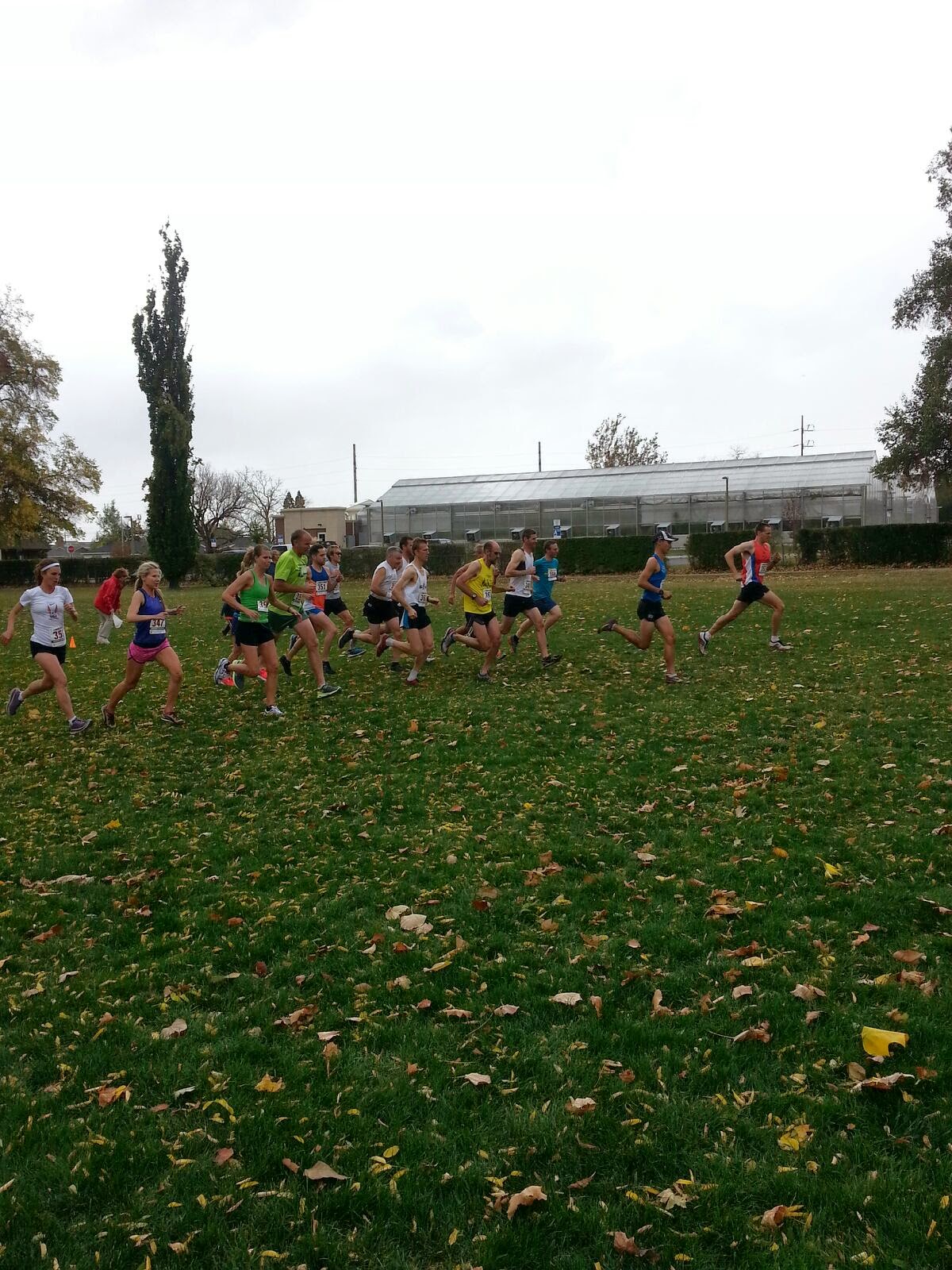
I took away two things from the 2014 USATF Utah Regional Cross Country Championship:

1. Cross Country is HARD!

2. Cross Country is definitely my favorite way to race.

I took out the first kilometer in 4:02, which was right around what I was shooting for. I was running hard but not all out, so I felt like I had some room to grow. But then kilometers 2, 3, and 4 had some hills. Quickly I was sucking air and trying not to panic. I had to slow down to about 4:20 per kilometer, but I told myself that it was OK to ease up, as long as I just kept going. The last half a kilometer or so was downhill so I was able to pick up the pace and have a strong finish.

The best thing about races is having other people to challenge you. During the middle portion I was hanging right behind these three guys that really helped pull me up the hills. And near the end a woman was coming up behind me, and I definitely wasn't about to get chicked, so I dug a little deeper to stay ahead of her.

My time was 21:59 (much slower than I had anticipated) but my Garmin said that the course was a little long, so my 5K time was actually closer to 21 minutes. It was fun, though, and definitely reminded me of my old XC days back in High School.

The race was a good indicator of where my fitness is at. My biggest asset right now is my leg strength; I've been lifting a lot in the last two months, and it definitely translated into a smooth, powerful stride. But my biggest liability was my lung capacity; 6:52 per mile on rolling hills was definitely as much air as I could move. I'll have to do some more long intervals to raise that threshold.

Thanks to my bro Court for taking these pics, and Marissa and Keaton for coming out to watch me run!


Thursday, October 30, 2014

The Perilous Psychology of Tapering

The scary thing about tapering is that at the beginning, when you first start scaling back your training, you feel pretty crappy; lethargic, burned out, unmotivated. The reason is that you are still tired from your last training block, but you aren't getting the same endorphin rush that follows you're hard workouts. It's the worst of both worlds.

But you have to take a break, because your body needs time to bounce back from the trauma that you've recently put it through. So you rest and try to relax. However the race day is soon approaching and you don't feel good yet. This is the scariest part. Because you know that if you were to do the race today, you wouldn't have what it takes to hit your goal. Not only that, it would be pretty painful trying.

After a few days your legs start to recover and you begin to feel restless. Anxious, excited to get out there are give it your all. You have so much pent up energy you can't sit still. And the key to tapering is timing it out so you reach that zone exactly on race day; too early and you're legs still feel like lead, too late and you begin to lose that fitness you've worked so hard to develop.

Right now I'm in that low phase where I still feel kinda crummy but things are starting to turn around. But I've tapered enough times that I know I'll bounce back, so I just need to sit back and have faith in my training.

Sunday, September 7, 2014

Out of exile

With the last Diamond League race behind us, the International Track and Field season is effectively over. At the beginning of the summer I gave an intro to some of the key players. And since then it's been exciting to watch it all play out.

One observation is that there has been a subtle shift in the attitude amid the American athletes. For a long time they saw themselves as the underdogs, saying things like "I'm just glad to be in the race" and "I did my best" and "We'll see how things plays out." I think that the east Africans had come to so thoroughly dominate the distance events that winning international meets seemed out of the question for anyone with fair skin.

But this season has been huge for USA Track and Field. it started with Emma Coburn surprising everyone by coming off an injury and winning the 3,000m steeple chase in Shanghai. Then Galen Rupp rocked the Prefontaine Classic by crushing the 10,000m with a world-leading time. And all through the summer, Jenny Simpson and Shannon Robury were finishing on the podium at major European meets in the middle distances. And in Brussels steeplechaser Evan Jager finally broke the American Record and finished strong in third place.

But more important than the wins and the medals is the way the athletes described themselves. I watched a lot of prerace and postrace interviews, and a common theme emerged: they were expecting to win. And if they did they were excited but confident, and if they didn't they chastised themselves for just missing the prize.

This transition is important, because you will only win the race if you believe that you can. Belief is not all you need, but it is an essential component. You must expect it, anticipate it. And after years of being the "best American" in the race, these elite athletes are finally ready to shoot for being simply the "best." And I am ready to watch them do it.

Tuesday, July 15, 2014

Handling The Heat Wave


Much like Hansel, Provo UT is so hot right now. Seriously guys, I'm on fire. With every day approaching 100 degrees, it makes even a simple run pretty tricky. So here are some tips for handling the heat:


1. Run early in the day

The coolest part of the day is dawn, so if you are willing to get up that early (or already do) this is how most people deal with it. I actually don't use this one, because I never feel good before I've had any water or food, but it's popular so I thought I'd include it.


2. Find an indoor track

BYU actually has a really nice air-conditioned track that is five laps to a mile so it almost feels like running on the normal oval (minus the blazing temperatures) and during the summer it is open almost all of the time. I don't think you even have to be a student to use it, so if you live in the area and want to sneak in, I wont tell anyone.


3. Go swimming beforehand

I noticed that this worked by accident last summer, because my friends and I would go swimming on a lazy, hot afternoon, and after being in the pool all day I found I was really refreshed and wanted to get up and move around. I remember one time when I even did repeat kilometers, my hardest interval workout, in 99 degree weather, and it wasn't too bad. I think there is even some science behind this, because Tim Noakes mentions pre-cooling in "Lore of Running", the idea being that if you lower your body temperature a little before the run, the heat will have to first raise it to the normal 98.6, then work on taking you past that, essentially acting like a temporary buffer and giving you more time before you overheat.


4. Get used to it

This is actually crucial if you are planning on racing in any hot-weather conditions. Running in the heat is a skill, one that you need to hone if you intend it to be part of your repertoire on race day. I'm focusing on shorter distances like 5 and 10 kilometers which are almost always first thing in the morning, so I'm not putting myself through much of this kind of suffering. But if you have a marathon or ultra coming up, no matter how early it starts it will almost certainly extend into the warmer part of the day so it pays to act like the Boy Scouts and be prepared.


5. Be realistic

The middle of the winter and the middle of the summer are excruciating in the high desert, so I plan on not being able to run my absolute best during these times because the environment is just so hostile. I trained hard in the spring and ran a great 5k right as the weather was starting to really heat up, and now I'm regrouping and getting ready for the fall when the temperatures will drop and I will be able to train and race at my best.

Tuesday, May 27, 2014

2014 USA Track and Field Overview

The Track and Field season is underway and I realized that the races aren't just a series of disconnected events, but rather a sprawling, epic story. There are heartbreaks and heroes, travails and triumphs, and a narrative that spans decades. It's Anna Karenina, it's Les Miserables, only with real people.

Someone recently told me they thought watching people run around a track was boring. It is unless you know who these people are or what this particular race means to them: maybe it's a comeback after years of injury, or another shot at breaking through a long plateau, or a chance for him or her to prove something. And the athletes all know each other, so there are friendships and rivalries and scores to settle.

With so many players it is easy to get lost, so I'm gonna be the "last time on..." that you get at the beginning of your favorite TV show and let you know what you have missed so far. The best way to do that is to highlight some of the most vibrant personalities in U.S.A. Track and Field:


Galen Rupp: The Prince


If his coach Alberto Salazar was the King of American distance running, then Galen Rupp is the Prince, a spiritual son and heir to the throne. Salazar told a 15 year old Rupp that he saw in him the potential to compete at the highest level, and since then his career as been an almost uninterrupted parade of staggering accomplishments: he ran 13:37 for the 5 K in high school, was a five-time NCAA Champion in college, won a silver medal  for 10000m in the 2012 Olympics, and currently holds American records in the 3000m, 2 mile, 5000m, and 10000m. Not a bad for only 28 years old, right? Now that he has essentially conquered the American field, he's set his sights on trying to beat the seemingly unstoppable Africans at the international meets.


_________________________________________________

Bernard Lagat: The Professional


At 39 years old he has been racing competitively for two decades, and just this winter he set a new American record in the outdoor 3000m proving he can still reach new heights. Each year for the last several years Lagat and Rupp have stolen records from each other, and although Rupp usually beats him in head to head races, Lagat has won more international medals. In interviews he has a broad smile and boundless enthusiasm, and when praised for his many accomplishments he graciously thanks his wife, his children, and God for enabling him to do what he loves. Hands down, a great guy.


_________________________________________________

Emma Coburn: The Comeback Kid


Wait, is this a model? No, she is a real runner, she just actually looks like this. Emma was the star 3000m steeple-chase runner at the University of Colorado and upon graduation instantly signed with New Balance, but right after she got injured and missed her first year of competition as a pro However, she came back in a big way by crushing the field in her first Diamond League race of 2014. Everyone is excited to see what she can do now that she is healthy again and ready to compete.


_________________________________________________


Matt Centrowitz, Jr.: The Boy Wonder


He's the guy in the front, which is a place he's used to. In 2011 at just 21 years old, he won the NCAA championship at 1500m, then won the American Championship, then earned a bronze medal at the World Championship. Centro really cracks me up: he talks constantly, bragging, joking around, trash talking, so much so that his teammates at the Nike Oregon Project like to set the pace of their group runs just fast enough that he will finally shut up. He kicked off the 2014 season by dominating the USATF High Performance Classic 1500m.

_________________________________________________

Brenda Martinez: The Underdog


Out of college no professional team wanted her, so she spent a year trying to figure out where to run and who would train her. Eventually Joe Vigil agreed to coach her which turned out to be a solid investment because last year she grabbed a bronze medal in the 2013 World Indoor Track and Field Championships (an inspiring race that I got to watch live: other runners went out too fast and faded, but she was smart and saved just a little for the end and ended up catching enough people to get a medal.) Martinez is so tough: she races competitively at distances ranging from 800m to 5000m which is an incredible spread that shows her true athleticism.

_________________________________________________

Will Leer: The Lumberjack


Although he is clearly the most robustly hirsute professional runner, I think the nickname "Lumberjack" fits him for more than just his hair. He has this nervous, wild energy during interviews (he casually swore while talking to Flotrack one time, which I thought was pretty funny because, surprisingly, you don't hear a lot of salty language when athletes talk to reporters.) Also, he doesn't run quite like other track runners: instead of a smooth, effortless stride he takes powerful, deliberate steps, as if his legs are devouring the track underneath. Good in college but not a standout, he has steadily made improvements in the handful of years since and after winning both the 3000m and the mile at the 2013 U.S. Indoor Track and Field Championships, and then winning the 2014 Wannamaker Mile, there is no doubt that he is one of the best middle distance runners out there.

_________________________________________________

Katie Mackey: The Rising Star


Katie is so off the radar that she doesn't even have a Wikipedia page, but she was the top American at the highly competitive Payton Jordan Invitational 5000m with a P.R. of 15:04 (I dare you to watch this interview and not love her.) She is a 1500m specialist, but if she is flirting with 15 minutes for the 5000m that puts her in serious contention in the longer events. Equal parts ebullience and sincerity, Katie Mackey truly lives the motto of her sponsor, Brooks: Run Happy.

(Perhaps her enthusiasm gets the better of her sometimes, like in this relay in the Bahamas where she just plowed head-first into an Australian runner during a hand-off. I don't mean to put her on blast, because she came back and helped her team get second place, but the Jennifer Lawrence move was pretty funny. Maybe that's part of her charm.)

_________________________________________________


You might be wondering how to follow the 2014 season because ESPN doesn't cover a lot of running, but there are a couple of websites with great content:

USATF.TV: Live coverage of many U.S. Track and Field events and interviews.

Flotrack.org: Some live events, but mainly behind-the-scenes material like interviews, special documentaries, workout videos, and links to interesting videos on other sites. An indispensable place for all things running.